


Hydraulic systems are part of daily truck operations. To work, they need to meet two conditions: pressure and flow rate. Controlling either of them gives control over the hydraulic system. Hence, understanding these conditions and how they work is important to controlling the system. Two distinct system designs have been developed to control the flow rate and pressures: open-loop or closed-loop hydraulic systems.
The terms “open-loop” and “closed-loop” distinguish system designs based on their technical construction. Each system denotes the nature of the hydraulic circuit employed within the system. Another distinction is the construction of the directional control valve.
What is an Open Loop Hydraulics?
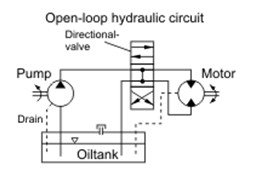
To understand the open-loop hydraulic system, consider a system in which a pump continues operating regardless of whether the system requires power. If the system does not need hydraulic pressure, the fluid will flow through lines and end in a reservoir, and the process will continue.
So, even in the idle state, these systems are characterized by a continuous flow of hydraulic fluid through the directional control valve. The fixed displacement pump operates consistently. It reduces the pressure when the system is unused. But, as soon as the actuator (e.g., a cylinder or motor) is engaged, the fluid flow is redirected to provide hydraulic power for the desired operation.
In short, flow is generated as the pump rotates. It is then directed back to the tank through hydraulic lines or a central passage within the directional control valve. The flow is directed toward the application of load, and pressure is generated. This happens when the directional control valve is stroked. It actuates the systems, and when the pressure exceeds the load, the load moves.
What components are involved in an Open-Loop Hydraulic System?
Four main components are involved in operating an Open-Loop Hydraulic System. These are:
- A fixed displacement pump for a consistent flow of hydraulic fluid.
- The directional control valves allow fluid to flow through or redirect it as required.
- A reservoir tank that will store the hydraulic fluid.
- Finally, the hydraulic lines Channel the fluid throughout the system.

What are the advantages of Open-Loop Hydraulic Systems?
The figure below explains the open-loop hydraulic system design. These are simply constructed hydraulic systems. Furthermore, this simplicity makes them easier to understand and maintain. The straightforward configuration leads to lower costs. The components are also less expensive as compared to the components of closed-Loop hydraulic systems.
This simplicity also contributes to ease of maintenance. For example, troubleshooting and repairs involve fewer complexities. Due to these advantages, these systems are widely used in applications such as older tractors and basic agricultural machinery, where single-function operations are sufficient, and cost-effectiveness is a priority.
| Feature | Open-Loop Hydraulics | Closed-Loop Hydraulics |
| Fluid Flow When Idle | Continuous flow through the system, reducing pressure | No flow; system maintains high pressure |
| Pump Type | Gear pump (fixed displacement) | Variable displacement pump |
| Energy Efficiency | Lower efficiency due to constant fluid flow | Higher efficiency; pump adjusts to demand |
| System Complexity | Simple design, easy to maintain | More complex, requiring precise components |
| Multi-Tasking Capability | Limited; only one operation at a time | Excellent; handles multiple tasks simultaneously |
| Typical Applications | Older tractors, basic machinery | Advanced machinery, industrial equipment |
| Cost | Lower initial and maintenance costs | Higher cost due to sophisticated components |
| Common Issues | Overheating, pressure drops | Pump noise, seal failures, pressure spikes |
| Valve Operation | Fluid flows continuously when idle | Valves remain closed when idle |
What Is Closed Loop Hydraulics?
Now that you have completely understood the open-loop hydraulic systems let us guide you through the second system. In a closed-loop hydraulic system, the pump’s rotation also generates flow. However, the flow is restricted to maintain the pump’s lubrication and to produce a standby pressure at the directional control valve. When a spool is caressed in a closed loop system, a passage is exposed for the flow to enter, and a pressure signal is transmitted from the directional control valve to the pump.
This works as a signal to the pump to generate the necessary flow to perform the work. In simple terms, closed-loop hydraulic systems maintain fluid at high pressure. They work even when the system is not in use, opposite to open-loop hydraulic systems. Unlike open-loop systems, the hydraulic pump in closed-loop hydraulics adjusts its output based on load demand, making it efficient.
What are the Components Specific to Closed-Loop Systems
Like open-loop hydraulics systems, closed-loop hydraulic systems also have four important components.
- It has a variable displacement pump, which is key difference between these two systems. This pump adjusts the flow and pressure based on the system’s needs.
- Pressure-control valves maintain the desired pressure level within the system.
- Thirdly, an accumulator stores pressurized fluid to meet sudden demands.
- A reservoir holds the hydraulic fluid when it is not in circulation.
 s
s
 s
sWhat are the advantages of Closed-Loop Systems?
Closed-loop systems offer several technical benefits over open-loop hydraulic systems. These distinct advantages make them ideal for high-load demanding applications. These systems provide high efficiency by matching pump output to the actual demand, significantly reducing energy wastage. A standout feature is the system’s capacity to regulate pressure and flow independently for each operation, which allows it to handle multiple tasks simultaneously without compromising performance. Closed-loop systems are highly versatile, enabling precise control and adaptability across various industrial and agricultural applications where performance and efficiency are critical.
What are the Common Issues with Open-loop and closed-loop hydraulic systems?
Just like all hydraulic systems, these two systems have some technical and operational issues that appear from time to time. All mechanical machinery has a life range and standard operating procedures. Which, if not followed, may raise some concerns. In a similar aspect, these are some of the issues that commonly appear in open-loop and close-loop hydraulic systems:
- Overheating problem is very common in open-loop hydraulic systems. It is because of the continuous circulation of hydraulic fluid even when the system is not in use. Heat is a form of energy, and this heat generation can lead to reduced system efficiency.
- Another common issue is leaks. These frequently arise from worn seals or damaged hoses. Seal failure is also prevalent in closed-loop hydraulic systems due to prolonged exposure to high pressures. Both of these issues cause a loss of pressure, and fluid outflow may occur due to these leaks.
- Then, a common issue is a drop in pressure. Pressure drops usually occur due to obstructions in the hydraulic lines or pump wear. The wear and tear within the hydraulic lines clog the lines, decreasing the system’s performance in operations. Please remember that hydraulic systems rely on consistent fluid flow.
- The fourth common issue is noise caused by cavitation and air trapped within the system. You need to bleed the air from the line.
- Furthermore, the noise indicates inefficiencies and potential damage to the pump if not addressed promptly.
- Pressure spikes are another frequent issue in closed-loop hydraulic systems. The pressure spike arises when the pressure control valves are malfunctioning. Other than pressure spikes, this also leads to system instability and component wear.
- Addressing these issues through regular maintenance and early detection is vital for the reliable operation of closed-loop hydraulic systems.
How to Troubleshoot, Maintain and Take Care of Open-loop and Close-loop Hydraulic system
Proper maintenance and care are essential for all kinds of hydraulic systems. You need to learn the components’ workings and system operation to troubleshoot. By learning how each component is connected and how it works, you can quickly troubleshoot the issue by general observation and inspection.
For this purpose, you must regularly inspect the hoses, seals, and connectors for wear or leaks. It will help you prevent unexpected breakdowns. One of the most critical factors is to choose the correct hydraulic fluid because compatibility is the most important factor in maintaining optimal performance.
Moreover, you need to keep the system clean. This will help you quickly analyse and assess any fluid leakage or noise. So, you need to make sure that there is no contamination. Contamination of any type, whether dirt, water, or other material, leads to component wear and, eventually, efficiency losses.
Lastly, adhere to the manufacturer’s guidelines for pump calibration. Always check the system pressure to keep operating within safe and efficient parameters.
Conclusion
Understanding the differences in constructing open-loop and closed-loop hydraulics is crucial for selecting the right system for your application. The involved prices and maintenance further makes it easier to choose the appropriate system that can help your work. One is simple, cost-effective, and suitable for basic machinery, while the other system offers high efficiency and versatility for advanced applications. So, you need to choose the system that aligns with your operational needs and maintenance capabilities.
You can contact our customer support team for more detailed insights or assistance.

