


Hydraulic reservoirs /tanks are not just simple fluid containers. From this article, I will bring you to explore it. You will find out they are the multi-functional components essential for a hydraulic system’s reliability, efficiency, and longevity. I spilt several aspects to discover it.
I. Primary Functions:
The reservoir’s functions are beyond storage; it has more critical uses
- Fluid Storage & Supply: Reservoirs store the hydraulic fluid (or system fluid) for the system. They make up for fluid lost during leaks or when actuators cycle.
- Thermal reduction: The reservoir’s surface area releases about 25% of the system’s heat, acting as its main heat sink. Size, material, and airflow are crucial for managing this heat effectively.
- Air Separation: Air bubbles separate from fluid in reservoirs thanks to adequate dwell time and surface area. Without this, systems risk cavitation, spongy actuator operation, and oxidation damage.
- Contaminant Settling: Water and heavy particles settle at the reservoir bottom due to gravity. This keeps contaminants safely distant from the pump’s intake passage.
- Mounting Platform: Reservoirs physically house pumps, motors, valves, filters, level indicators, and breathers.
II. Sizing the Reservoir:
The reservoir’s size must accommodate heat rejection, air release, contaminant settling, and fluid demands of the system.
Effective volume (between min/max levels) = 3 to 5 times pump flow rate (Q) per minute. (e.g., 20 GPM pump → 60-100 Gallon effective volume).
Some Key Influencing Factorsin sizing the reserviors:
- Heat Load: Systems that operate continuously,have high-power demand or are in high-ambient temperature may require larger volumes-typically to 8 times the flow rate or more.
- Fluid Grade: Higher viscosity fluids need larger volumes for better settling and air removal. If you have few knowledge about hydraulic oil, check the article:Exploring Hydraulic Oil: Its Uses and Importance
- System Complexity: Multiple actuators, large accumulators, or long fluid lines, additional volume may be needed for thermal expansion and surge damping.
- Space Constraints: Physical limitations concerning installation must be taken into account.
- Level Management: The minimum fluid level should prevent pump inlet vortexing and cavitation, typically maintaining a distance greater than three times the inlet pipe diameter from the tank bottom. The maximum level should leave 10-15% headspace to allow for thermal expansion and foam.
III. Construction & Materials of Hydraulic Reservoirs
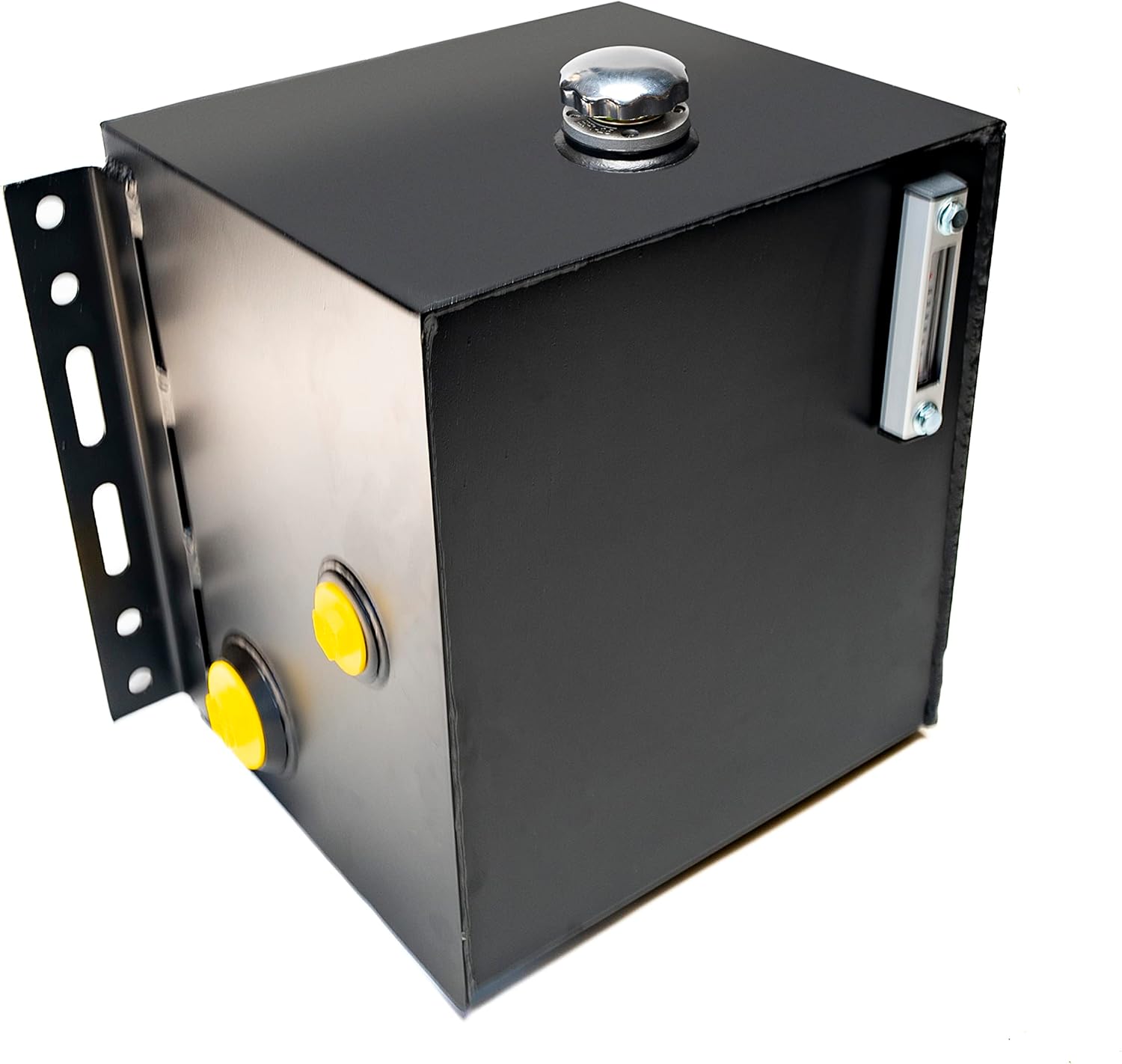
There are Common Shapes of reserviors
- Rectangular: Thisi is the most common shape. Because it maximizes surface area for heat transfeing, simplifies internal baffling/component mounting, and component mounting, and optimizes space utilization.
- Cylindrical: Cylindrical tanks handle pressure and vacuum better, but their shape wastes space and complicates internal mounting. You’ll typically see them in high-pressure or specialized setups.
Materials for making hydraulic Reservoirs
- Carbon Steel tank: Need manholes for cleaning and checks in larger tanks. Lower cost but rusts more easily – not for food/pharma.
- Stainless Steel tank: High corrosion resistance, easy to clean, long life; suitable for special environments. However, it is costly, much heavier, and slightly more difficult to process and weld.
- Aluminum/Plastics tank: Save weight for the mobile industry (trucks/machines) or handle weird chemicals. It won’t rust like steel.

V. Essential Accessories
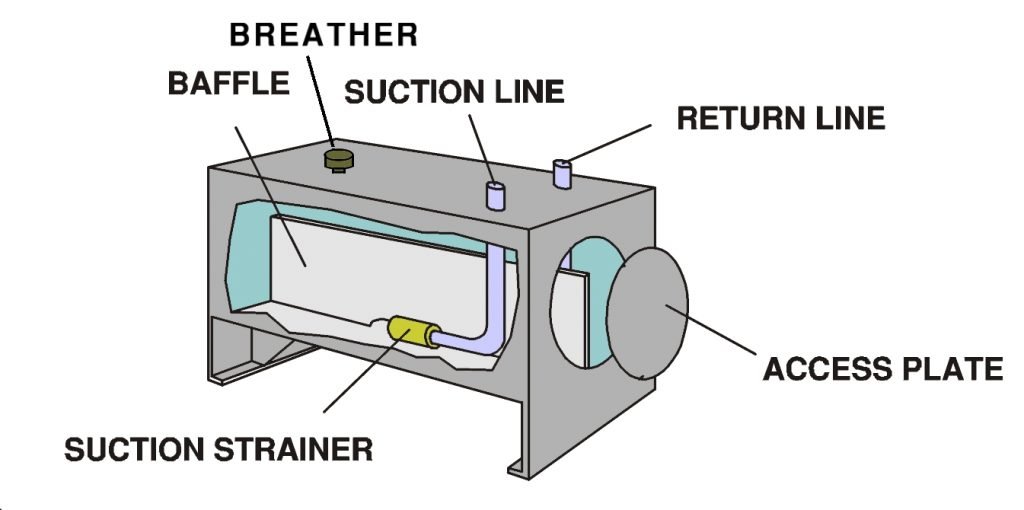
Baffles: They are essential to separate the pump suction (inlet) zone from the return line zone. Function: Baffles increase the fluid residence time for cooling, deaeration, and settling. They prevent hot, aerated fluid from directly entering the pump suction.
Breather (Air Filter): The breather equalizes pressure during fluid level changes and filters incoming air, serving as the main entry point for contaminants. Ensure the filtration rating (e.g., β₅(c) ≥ 75 or β₃(c) ≥ 200) matches the system’s cleanliness requirements, and the flow capacity meets maximum pump suction and return flow rates.
Level Indicators: Available types include sight glasses, float switches (min/max alarms), magnetic level gauges, and transducers (electronic output).
Temperature Indicator/Gauge: Monitors fluid temperature, with alarms typically set around 65°C (150°F).
Drain Plug: Positioned at the lowest point, magnetic drain plugs are recommended.
Filler/Breather Cap: A sealed port for adding fluid that often includes the breather.
Cleanout Covers: Smaller access points for cleaning when full manhole access isn’t practical.
VI. Installation & Maintenance Hydraulic reservoir
Reservoir Installation
- Location: Ensure pump inlet is below minimum reservoir level for gravity feed. If above, a pressurized (supercharged) reservoir or charge pump is mandatory.
- Mounting: Use a rigid, level base and avoid welding supports to a filled reservoir to prevent distortion.
- Initial Cleanliness: Thoroughly clean before the first fill to eliminate contaminants. Flushing may be needed.
Reservoir maintenance
Regular Level Checks: Ensure that fluid levels are maintained within the operating range.
Temperature Monitoring: Early identification of cooling issues or system overloads is essential.
Fluid Analysis: Conduct periodic sampling and testing to assess particle count, water content, viscosity, and total acid number (TAN). This is crucial for predictive maintenance.
Breather Maintenance: Replace the breather based on the pressure differential indicator or adhere to scheduled replacement intervals.
Conclusion:
The hydraulic reservoir is not only a tank, it’s an engineered life-support system. Its size, internal design (especially proper baffling), construction quality, accessory selection, and maintenance practices are essential to the health of the hydraulic system. Inadequate reservoir design or neglect is a primary root cause of failures like overheating, cavitation, accelerated component wear, and fluid degradation. Treating the reservoir as one of the “beating hearts” of a hydraulic system to achieve optimal machine performance, reliability, and service life.