


You may know those monster machines lifting tons of steel or bulldozing through concrete. You might then wonder what all that power is. It is the hydraulic pressure. Just like other mechanical design requirements, this too is engineered and designed before putting hydraulic machines into action. In this article, you learn how to calculate the hydraulic pressure.
Understanding Basic Components of a Hydraulic System
To understand hydraulic pressure completely, you need to recall the basic components of a hydraulic system. A hydraulic system consists of hydraulic pumps, valves, cylinders, and hydraulic oil along with some actuators, all working together in perfect harmony. The hydraulic pump is the heart of the system that pushes hydraulic fluid through the pipes.
Hydraulic valves control where the fluid has to go, and the cylinder converts that pressure into mechanical force. To understand this in simple terms, think like you are pressing down on a syringe filled with oil. A hydraulic system works on the same principle but at a large-scale level to lift even an entire building if you want.
Cylinders And Actuators Formula:
Symbol | Description | Units |
Q | Flow Rate | l/min |
A | Net Area | Cm2 |
v | Piston Speed | m/sec |
| F | Force | N |
| p | Pressure | Bar |
| D | Cylinder Bore | cm |
d | Rod Diameter | cm |
V | Volume | litres |
| L | Stroke Length | cm |
| t | Stroke Time | sec |
Net Area Piston Side: A= (π×D^2)/4
Net Area Rod Side: A= π/4× (D^2-d^2)
Cylinder Force: F= A×p×10
Cylinder Volume: V= (A×L)/1000
Required Flow: Q=A×v×6
Stroke Time: t= (0.06×A×L)/Q
Or Stroke Time: t= (60 × v )/Q
Power: P= (F×V)/1000
Pumps & Motors Formula:
Symbol | Description | Units |
Q | Flow Rate | l/min |
V | Displacement | cc |
n | Shaft Speed | rpm |
| P | Power | kW |
T | Torque | Nm |
p | Pressure | Bar |
Power – Pump: P= (Q×p)/600
Power – Motor: P= (T×n)/9549
Flow: Q= (V×n)/1000
Torque: T= (p×V)/(20×π)
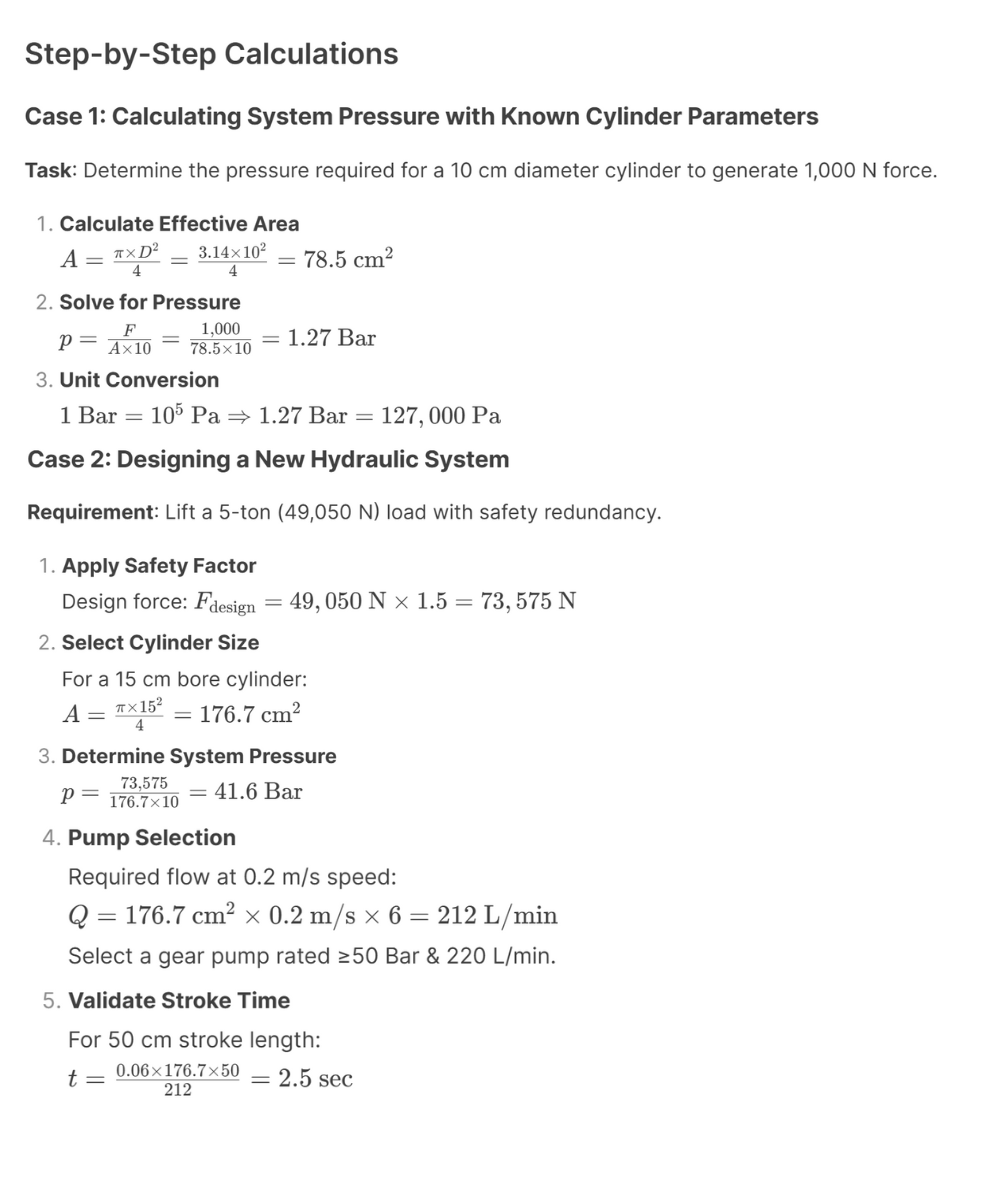
Key Design Rules
- Unit Consistency: Strictly use cm² for area, Bar for pressure, and N for force.
- Safety Margin: Operate at ≤80% of component pressure ratings.
- Energy Efficiency: Verify power using P=(Q×p)/600
- Dynamic Validation: Use t=(0.06×A×L)/Q to check cycle times.
Critical Note: Undersized systems risk failure; oversized systems waste energy. Always validate with hydraulic simulation software.

