


Counterbalance valves are vital components to control load and give stability, and safety during operations. These valves maintain constant pressure and prevent uncontrolled movements. But, based on operation and technicalities, there are various classifications of these valves, that you will be learning in this article.
What are the types of Counterbalance valves in Hydraulic Systems?
We will now deep dive into the types of counterbalance valves without going into the basics of technical specs. For a quick revision, these valves are instrumental in applications requiring controlled descent, load-holding capabilities, or steady operation, such as cranes, forklifts, and construction equipment. However, you can learn more about a counterbalance valve here.
Counterbalance valves can be broadly classified into three main types:
standard capacity counterbalance valve
Pilot-operated counterbalance valves(Vent)
Inline counterbalance valves
Each type has specific design features and applications.

Direct-Acting Counterbalance Valves
Direct-acting counterbalance valves, often called “load-holding valves,”. These are the simplest and most cost-effective types. These valves operate by maintaining a pre-set pressure to hold a load in place until the hydraulic system or operator moves it. You will see their most common applications in forklifts and dock loaders. It is essential in lifting and holding loads. The direct-acting valves prevent sudden descents when hydraulic pressure drops.
Advantages and Limitations of Direct-Acting Counterbalance Valves
These valves are widely chosen for applications demanding basic load control without breaking the budget. Moreover, their mechanical simplicity makes them easy to maintain and install, saving time and cost in operation. With all this, there are some limitations as well such as it provides basic control features and is temperature sensitive.
So, in short, direct-acting counterbalance valves are a solid choice for straightforward load-holding applications. However, they fall short when advanced control or adaptability to different conditions is required. That is why there are other types of counterbalance valves.
Pilot-Operated Counterbalance Valves
Pilot-operated counterbalance valves incorporate a pilot mechanism that provides more precise and flexible control of pressure. These valves adjust to varying load conditions and system demands. This feature makes them indispensable in complex hydraulic operations where the above-mentioned type may not be an optimal choice.
These valves are widely used in applications prioritizing precise lifting and lowering control, such as construction cranes or manufacturing hoists. As you have seen the crane operations are quite complex and need precision control, that is where Pilot-operated valves come into use.
 Advantages
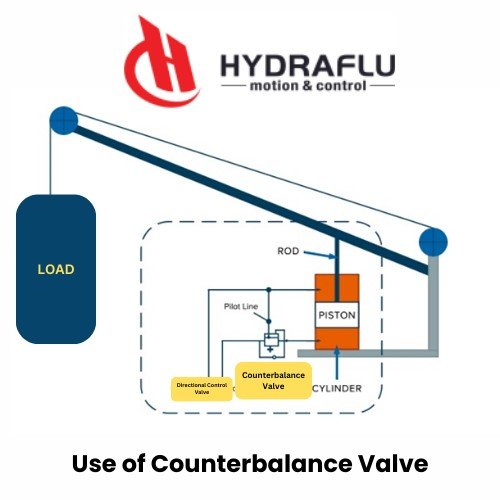 Advantages
They allow gradual and controlled movement of loads, ensuring smooth and safe operations. Another feature is their adjustability to different system pressures. Due to this, you can use it with a variety of machinery. Moreover, as they operate at lower system pressures, so they provide operational cost savings and also reduce wear on hydraulic systems.
Limitations
There are also some limitations such as higher costs due to their advanced design. But, that is with all the equipment where performance comes, price increases. The other factor is complex maintenance. Because. these valves are more elaborate in design, they require skilled maintenance and frequent calibration to function optimally.
But overall, Pilot-operated counterbalance valves are the preferred choice for applications requiring adaptability, precision, and efficiency.
Inline Counterbalance Valves
Inline counterbalance valves are compact and installed directly in the hydraulic line between the actuator and the load. These valves excel in restricting hydraulic fluid flow, ensuring stable and controlled actuator movements under load. Due to this feature, they are used in excavators and Backhoes. Also, they are extensively used in other construction equipment to stabilize multiple actuators and simultaneous control of hydraulic functions. Moreover, they are used with machines with space constraints. Their compact design makes them suitable for applications where installation space is a concern.
Advantages and limitations
Their compact design enables installation in systems where space is at a premium. Moreover, inline valves perform reliably under varying load conditions, ensuring control even in rugged operational environments. But, by restricting hydraulic flow, these valves may not be suitable for systems requiring high-speed motion or high flow rates. Also, installing inline valves demands precision, which adds complexity during setup and system integration.
Following table provides a quick summary of all what you have learned till now in this article.
| Valve Type | Applications | Advantages | Disadvantages |
| Direct-Acting | Forklifts, Loaders | Simple, cost-effective, easy to maintain | Limited control, temperature-dependent |
| Pilot-Operated | Cranes, Hoists, Mobile Machines | Precise control, versatile, energy-efficient | Expensive, complex maintenance |
| Inline | Excavators, Backhoes | Space-efficient, robust under load variations | Restricted flow, intricate installation |
By selecting the appropriate valve type based on the application’s precision, space, and cost requirements, you can achieve optimal safety and functionality.
So, Why the Right Counterbalance Valve Matters in Hydraulic Systems
Counterbalance valves do more than just hold loads that you have learned. They enhance hydraulic system efficiency and protect valuable equipment. Also, they ensure safety in high-stakes environments. So, you need to find the right hydraulic system requirement such as pressure, the need such as lifting or loading, space constraints, load control demands, types of threads, and precision requirements. This all will help you to find the right type of counterbalance valve to install and use.
Invest in the right valve for your hydraulic system today with Hydraflu and make your business succeed by leaps and bounds.

