


A hydraulic lift is a device that relies on one or more pressurized pistons to raise a heavy load into the air. Hydraulic lifts are used in most industries today and they simplify heavy lifting. They are what allows car lifts, cranes, and other amazing equipment to function.
What is a Hydraulic Lift?
A hydraulic lift is a specialized device with one or more cylinders that rely on fluid pressure to rise in height. A compressor mechanism is used to increase the pressure within each lifting cylinder, and the pressure causes the cylinder to expand.
Generally, cylinders expand upwards creating a vertical lift, but in the car of a scissor lift the cylinders expand at a 45-degree angle to create the device’s lifting power.
Why are Hydraulic Lifts Relied Upon in So Many Applications?
Hydraulic lifts are used in most industries today because they make it easy to lift heavy loads in a slow and controlled manner. With a properly designed hydraulic lift, it’s possible to lift thousands of pounds into the area slowly and safely.
The lift lower loads down to the ground just as easily by releasing their built-up pressure slowly. Hydraulic lifts are compact as well, enabling you to achieve impressive lifting forces in a confined space.
How Does a Hydraulic Lift Work?
Hydraulic lifts function based on Pascal’s law to store mechanical work up for use as a lifting force. When pressure is applied to a fluid that cannot be compressed, the fluid becomes pressurized uniformly in all areas. Lifts harness this law by creating a narrow cylinder for building pressure, and a wide cylinder for applying pressure.

If you glance at the diagram above, it’s easy to see how a narrow cylinder is used to build pressure and a wide cylinder is used to release it. Hydraulic lifts use a narrow tube to build pressure because a narrow tube is easier to compress, requiring less rugged equipment to build the pressure with. That built pressure is directed in the path of the arrows where it flows through one-way valves. As the narrow cylinder is pumped the pressure level builds on the side of the large cylinder, creating a tremendous amount of pressure that can lift vehicles or even much heavier objects.
Different Types of Hydraulic Lifts
While the principles behind hydraulic lifts are all the same, there are different forms of lifts used today. Understanding some of the different types can help you choose an option for your needs.
Scissor Lift
A scissor lift utilizes one or more hydraulic cylinders, a sturdy base, a lifting platform, and multiple scissor arms. The cylinders create the lifting force to raise the lift platform vertically, and the scissor arms ensure that lifting force is applied evenly for a sturdy platform.
Single Post Lift
Single-post lifts are used in numerous applications in many different industries. They employ a single cylinder to lift in one direction, usually vertically. Single-post lifts are compact and can still be used to apply thousands of pounds of pressure.

Two or Four Post Lift
Most hydraulic lifts rely on vertically oriented hydraulic cylinders and compressors to raise and lower heavy loads. A two-post lift relies on two cylinders, while a four-post lift uses four to raise a large platform. Each hydraulic cylinder is rated to lift a specific amount of weight, and several are used together to increase the lifting power of the device.
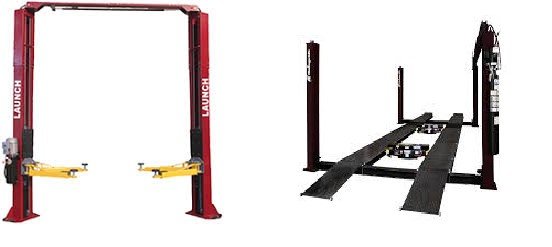
Below two and four post lifts are depicted. A four-post lift provides a more stable lifting force, but a two-post unit is more compact and still delivers enough power to lift most vehicles.
Proper Maintenance Practices
To ensure a hydraulic lift continues to operate properly, it must be carefully maintained. The maintenance process begins by maintaining a proper hydraulic fluid level and by replacing old hydraulic oil with new oil. A technician should regularly verify that hydraulic fluid levels are high enough for proper performance. If the level is too low additional fluid can be added.
Over time hydraulic fluid or hydraulic oil degrades. As the fluid degrades it does not compress and lift as well, and it does not lubricate the internal components as effectively. This leads to improper performance and eventual damage to the system.
To combat this issue hydraulic fluid must be replaced periodically. The replacement cycle is based on the type of lift as well as the fluid being used, and an experienced technician should know how often to replace fluid.
Selecting the Proper Hydraulic Lift Type
When choosing a hydraulic lift for your application, you must consider how much weight must be lifted, the distance of the lift, as well as the clearance you have available for your chosen use case. It’s also essential to consider what your budget is for the lift. All these details help determine which lift is the right option for your application.
The most important consideration is the weight to be managed, and the lift must always exceed the overall weight requirements by a comfortable margin for safety reasons.
Work with a professional to help you determine how much clearance you have for your hydraulic lift. Choose a unit that fits into the available space, including the motor or compressor that comes with the system.
Your chosen lift must also provide the lift distance that your application demands. You must consider the maximum lift of the unit and determine if the chosen hydraulic lift type will work for your use case.
It’s essential to consider all these elements and more when choosing a hydraulic lift for your business application. Work with a professional to help you decide which lift is the right option and to help you get the proper type of lift as well.
Conclusion
A hydraulic lift is an impressive piece of machinery that’s essential in any business that must regularly lift heavy objects. By learning to understand the technology, you’ll know how to make hydraulic lifts work for you, how to choose the right lift for your application, and how to maintain your lift so it continues to perform for many years.

